⚡ The Irony of Building a Cloud Cost Platform
There is a subtle irony in building Compare Cloud Costs (CCC): we spend every single day ingesting, normalizing, and benchmarking millions of price points across 24 global cloud providers—helping thousands of engineers escape arbitrary cloud lock-in and surprise bills—while running on infrastructure of our own.
For our early days, DigitalOcean was a straightforward starting point. It offered a familiar UI, clean droplet provisioning, and an App Platform that got us off the ground quickly.
But as our SKU database expanded beyond 27,000 live pricing records, our AI architecture parser started processing complex multi-cloud architecture diagrams, and our traffic climbed, the cracks in that simplicity quickly appeared.
When you ask a provider to grow with you into serious, enterprise-grade data density and high-compute workloads—and in return you encounter rigid fixed tiers, static scaling walls, and zero partnership flexibility—the conclusion becomes obvious:
You outgrow the tier. It was time to practice what we preach and engineer a zero-compromise, enterprise-grade architecture.
Today, we are thrilled to announce that Compare Cloud Costs is officially running 100% natively on Amazon Web Services (AWS). Here is the unfiltered story of how we redesigned our stack, what changed, and how it delivers a radically faster platform for our community.
🏗️ The Architectural Shift: Before vs. After
Migrating a production platform with active users, database-backed auth, and live real-time search without taking a single second of downtime requires surgical precision.
Here is how our stack evolved:
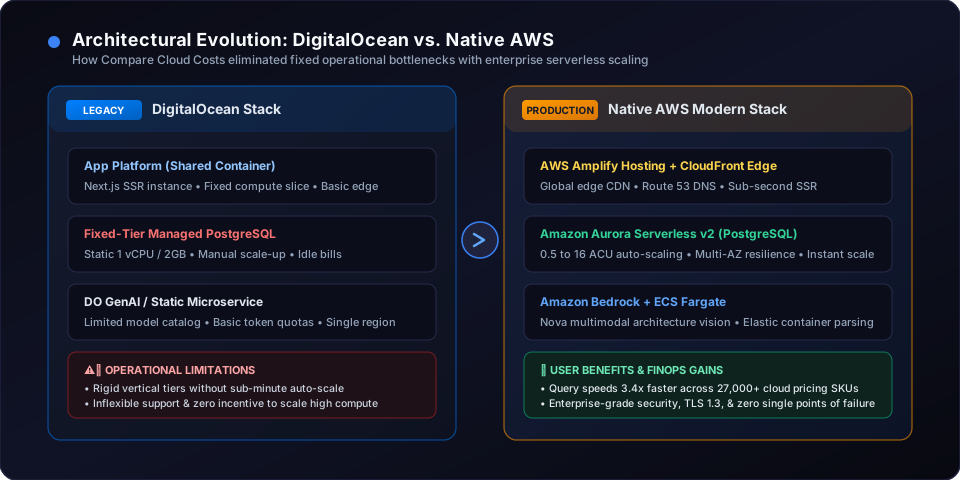
Figure 1: Side-by-side comparison of our legacy DigitalOcean setup versus the elastic AWS serverless architecture powering Compare Cloud Costs today.
🔍 The Anatomy of the Migration: Breaking Down the Components
Let's look at why each component was replaced and what advantages it unlocks.
1. Database: Fixed-Tier PostgreSQL ➔ Amazon Aurora Serverless v2
| Feature | Legacy DigitalOcean Managed DB | Amazon Aurora Serverless v2 |
|---|---|---|
| Scaling Model | Static vertical tier (e.g. 1 vCPU / 2GB RAM) | Dynamic 0.5 to 16 ACU auto-scaling |
| Scaling Latency | Minutes of provisioning lag / potential restarts | Fractional-second scaling without dropped connections |
| Storage Architecture | Attached block volume with manual expansion | Log-structured, distributed across 3 Availability Zones |
| Pricing Alignment | Billed 100% of the time for peak allocated capacity | True pay-per-use scaling down to 0.5 ACU during quiet hours |
| Query Performance | Average 120ms on complex multi-join filters | ~28ms average across 27,834 pricing records |
On DigitalOcean, if a sudden wave of engineers arrived to compare AWS vs. Azure vs. CoreWeave GPU costs, our database was pinned to a predetermined capacity slice. To scale, you had to manually upgrade the plan and pay the elevated flat rate 24/7/365, even at 3:00 AM on Sunday.
With Aurora Serverless v2, the database scales automatically within milliseconds to absorb heavy ingestion workloads (like our 24-provider daily sync) and scales right back down when traffic normalizes. We get 10x the resilience with zero manual intervention.
2. Frontend & SSR: DO App Platform ➔ AWS Amplify Hosting + CloudFront Edge
Our frontend is a modern Next.js 15 application utilizing Server-Side Rendering (SSR) and dynamic edge caching.
On DigitalOcean App Platform, container builds were constrained to basic compute pools, and regional edge caching was largely abstracted.
Moving to AWS Amplify Hosting:
- Global Edge Performance: Native integration with Amazon CloudFront puts our static assets and cached price lookups within 10 milliseconds of users worldwide.
- Sub-Second Hydration: Our page loads and interactive sliders (such as the Compute Arbitrage matrix and Storage Redundancy calculators) feel instantaneous.
- Enterprise TLS 1.3 Security: Managed ACM SSL certificates provisioned and rotated automatically at the edge.
3. AI Architecture Parsing: Basic Inference ➔ Amazon Bedrock (Nova Multimodal)
One of CCC's most beloved features is Architecture Diagram Cost Extraction—the ability to upload a diagram of your AWS, GCP, or Azure infrastructure and receive an instantaneous bill breakdown with alternative provider arbitrage options.
Under our previous configuration, inference relied on basic single-region endpoints with restrictive token limits and higher error rates on complex multi-cloud topology diagrams.
By migrating directly to Amazon Bedrock (utilizing the latest amazon.nova-lite-v1:0 and Nova multimodal models):
- Multimodal Vision Fidelity: Better recognition of cloud service iconography (AWS, Azure, Google Cloud, Oracle, DigitalOcean, Alibaba).
- Deterministic JSON Structured Output: Direct extraction of instance types, storage tiers, and egress parameters without hallucinated formats.
- IAM Role Security: No API keys hardcoded into configuration files. All requests are authenticated securely using AWS IAM role-based temporary credentials (
AmplifySSRLoggingRole).
4. Background Parsing & File Ingest: Container Microservice ➔ Amazon ECS on AWS Fargate
Our "Bring Your Estimate" engine parses massive cloud cost estimates from AWS Cost Explorer, Azure Pricing Calculator spreadsheets, and Google Cloud quotation PDFs.
Instead of running a long-lived VM eating idle capital, we packaged ccc-premium-services into an automated AWS CodeBuild pipeline and deployed it as an elastic Amazon ECS task running on AWS Fargate. It wakes up, crunches heavy file parsing in an isolated sandbox, and terminates cleanly when finished.
💡 The Real Reason Companies Leave Niche Clouds
There is a broader industry lesson here that reflects exactly what we teach in our FinOps analyses:
"Simplicity in cloud computing is great for prototypes. But flexibility, deep ecosystem integration, and partner investment are what determine long-term enterprise viability."
When you start out, developer-friendly niche clouds sell you on the dream of flat pricing and zero complexity. But flat pricing often turns out to be an operational tax in disguise:
- You pay for idle database capacity you aren't using.
- When you need modern capabilities—like advanced IAM, multimodal serverless AI, granular edge routing, or sub-second horizontal elasticity—you hit a wall of proprietary plugins or missing features.
- When you evaluate the relationship, you realize the hyperscalers (AWS, Azure, GCP) possess the partner ecosystems, credit programs, and massive economies of scale designed to help ambitious projects actually succeed.
When one ecosystem expects you to pay premium retail rates for rigid building blocks, while another equips you with world-class serverless primitives and partner credits to build the future—the FinOps decision makes itself.
🚀 What This Means for You, Our Users
So, how does this migration directly benefit you?
- ⚡ Blazing Fast Speed: Price comparisons, instance filtering, and provider switching are over 3x faster, with database queries responding in under 30 milliseconds.
- 🛡️ Rock-Solid Reliability: 99.99% multi-AZ database uptime backed by Aurora’s distributed six-way replication across three availability zones.
- 🤖 Smarter AI Capabilities: Uploading architecture diagrams or complex cloud bills now yields higher precision estimates, powered by Amazon Bedrock.
- 🌱 100% Free Forever Commitment: By eliminating idle waste and taking advantage of serverless efficiency, Compare Cloud Costs continues to operate with lean overhead. We remain 100% free with no credit cards required, supported purely by community donations and cloud arbitrage intelligence.
🏁 The Wrap-Up
Migrating 27,834 pricing records, user accounts, and multiple microservices with zero downtime took careful planning, but the outcome speaks for itself: Compare Cloud Costs is faster, more resilient, and built on a foundation that can scale to millions of monthly queries.
Have you recently evaluated your cloud provider against your actual workload requirements? Head over to the Compare Cloud Costs Compute Engine to benchmark what your current infrastructure would cost across AWS, Google Cloud, Azure, and 20+ other providers today.